
CIRM, FoLAP, and the MRI invite abstract submissions for the session ‘Mountain Commons: Historical Development, Transformations, and New Forms of Commons in Mountain Regions’ at the 24th Swiss Geoscience Meeting.
Researchers working on mountain commons, collective resource governance, and related topics are invited to submit abstracts to a session co-convened by the Interdisciplinary Centre for Mountain Research (CIRM), the Forum Landscape, Alps, Parks (FoLAP), and the Mountain Research Initiative (MRI) at the 24th Swiss Geoscience Meeting, which will take place 20–21 November 2026 in Fribourg, Switzerland.
The annual Swiss Geoscience Meeting, organised by the Department of Geosciences of the University of Fribourg and the Platform Geosciences of the Swiss Academy of Sciences (SCNAT), brings together scientists and practitioners from across the geosciences for two days of discussion, networking, and scientific exchange.
Among the 34 scientific symposia planned for the meeting, CIRM, FoLAP, and MRI are co-convening the session:
26. Mountain Commons: Historical Development, Transformations, and New Forms of Commons in Mountain Regions
Conveners: Emmanuel Reynard, Jeanne Fournier, Iago Otero, Carolina Adler, Glenn Hunt, Elisa Frank
Interdisciplinary Centre for Mountain Research, University of Lausanne; Forum Landscape, Alps, Parks, Swiss Academy of Sciences; Mountain Research Initiative
Mountain regions are facing many challenges related to their environmental and sociopolitical contexts (reduced agricultural production, natural hazards, difficulty of access, peripherization, etc.). Collective action and commons are ways to cope with these challenges. Historically, numerous common institutions have developed and evolved in many mountain areas to collectively manage natural resources (pastures, water, forests) or infrastructures (irrigation channels, mills, ovens, natural hazard protection structures).
During the 20th century, most of these commons have changed and have even disappeared for various reasons. Some have remained relatively stable. Others have been integrated into larger, more complex systems of resource management (e.g., with the development of hydropower schemes in mountain catchments) or have been combined with public institutions for the management of services or activities (e.g., forest management). Moreover, the functions of several of these historical commons have expanded (e.g., agricultural commons [alpine pastures, irrigation channels] that are now also tourist spaces or infrastructure). Most historical commons are now to be considered as transformed commons. In parallel, new forms of mountain commons have emerged and are structured around various types of resources. Examples of new mountain commons include participatory cafés, grocery stores, mountain heritage restoration associations or participatory management bodies for mountain huts.
We invite scientists from geosciences and other disciplines to an interdisciplinary exchange around the mountain commons and their multiple characteristics and management challenges in the 21st century. Conceptual contributions as well as case studies from the Alps and other mountain regions on historical commons, transformed commons, new commons, management and internal governance challenges, institutional issues, and commoning dynamics are particularly welcome.
The deadline for abstract submissions is 28 August 2026. Abstracts may be submitted for oral or poster presentations. Full details of all sessions and submission guidelines are available on the Swiss Geoscience Meeting website.
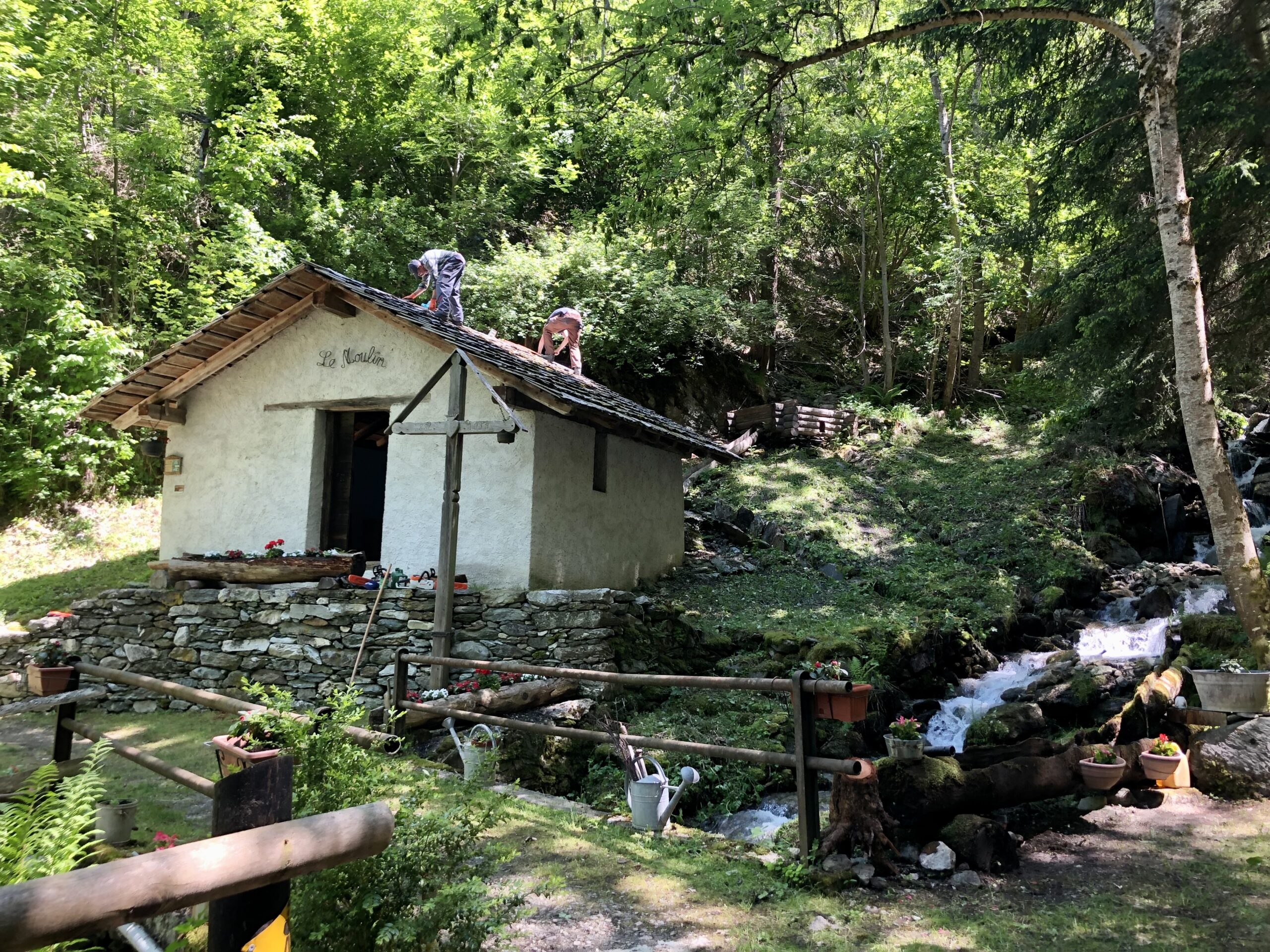
Cover image: Maintaining mountain commons in Fang village, Anniviers valley, Switzerland (2025). Image credit: Loïc Giaccone.